The phone line switch-off: what happens on 31 January 2027 (in plain English)
Your landline has been quietly doing its job for decades. Plugged into the wall, never needs charging, works in a power cut. Lovely. Unfortunately, the network behind it is being switched off.
On 31 January 2027 the UK retires the old copper phone network (the techies call it the PSTN). Every landline in the country is moving to a "digital landline" that runs over your broadband instead.
Sound worrying? It mostly isn't. But there is one thing everybody should know about, and it's to do with power cuts. Let's go through it, no techno-babble.
What's actually changing?
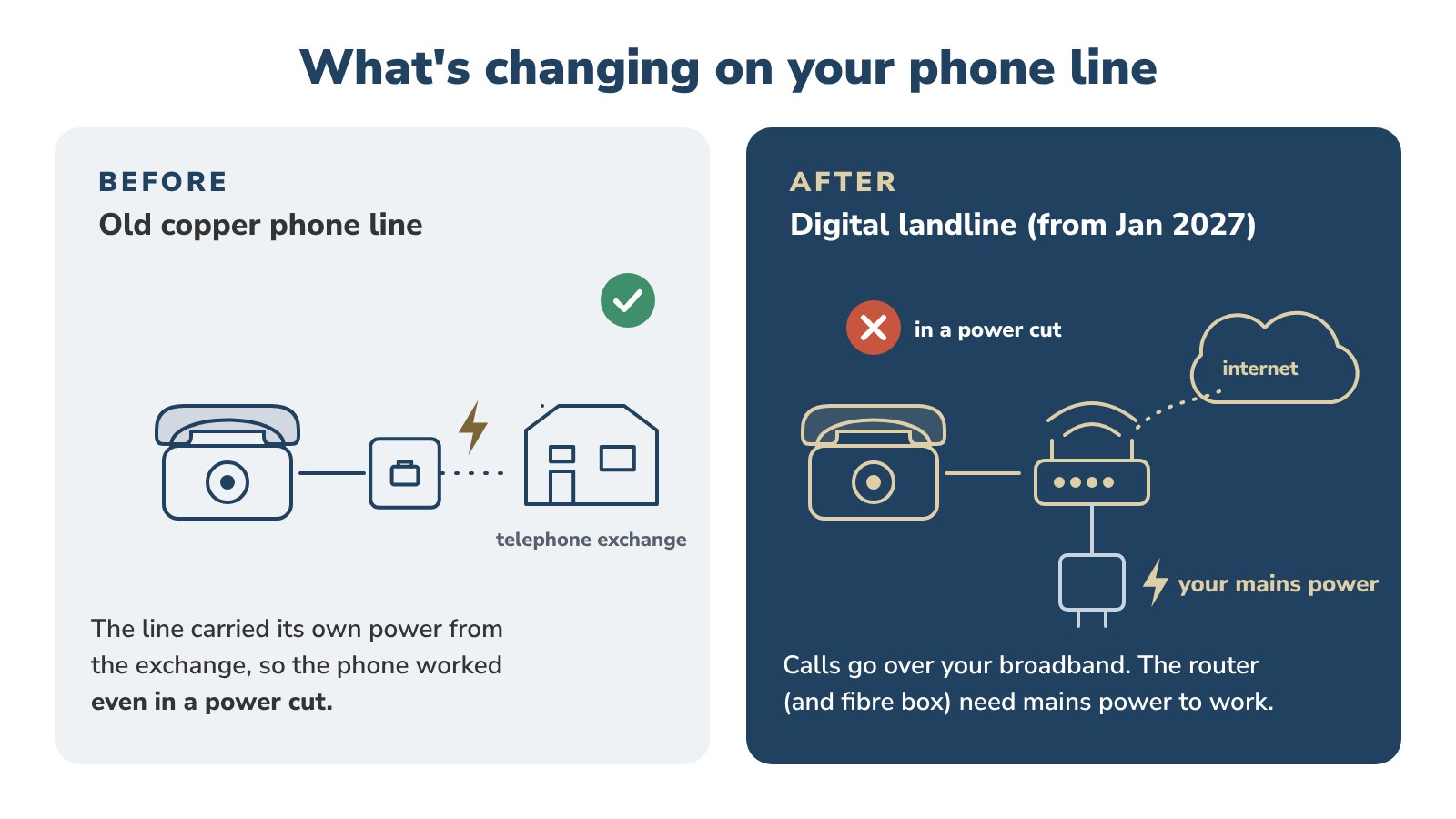
Before: your phone plugged into the socket on the wall. The phone line carried its own little bit of electricity from the telephone exchange, so the phone worked even when your house had no power.
After: your phone plugs into your broadband router (or a small adapter box). Calls travel over the internet. Same phone number, same handset in most cases, and calls should sound as good or better.
Most people won't notice much. Your provider (BT, Sky, TalkTalk, Vodafone and so on) should contact you, switch you over and tell you where to plug the phone in. Over 95% of BT's landline customers have already moved.
The catch: power cuts
Here's the bit that matters. A digital landline needs electricity in your home to work. Your router needs power. If you have full fibre, the little fibre box on the wall needs power too.
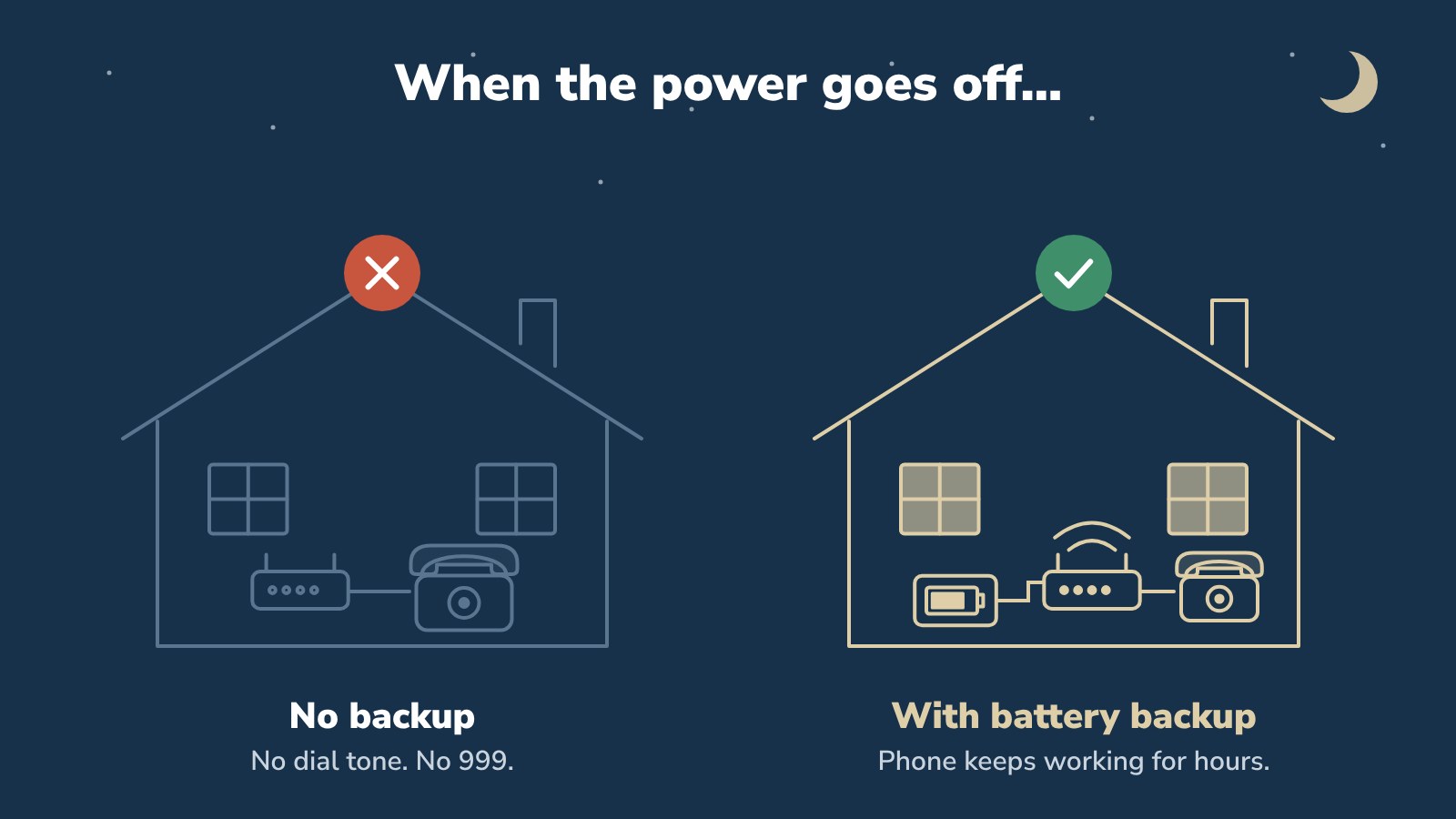
So when the power goes off, so does your landline. No dial tone, no calls in, no calls out. Including 999.
If you have a mobile phone with a decent signal, that's your backup. But here in the New Forest, "decent signal" isn't a given. Plenty of homes in the Forest have one bar on a good day, and none at all in the kitchen.
Who should think about power backup?
You should, if any of these sound like you (or a parent or relative):
You rely on your landline and don't have a mobile, or don't use one much
Your mobile signal at home is poor (check yours with our mobile signal checker)
You have a personal alarm or telecare pendant, fall sensor or similar, that calls out over the phone line
You have an intruder or fire alarm that reports over the phone line
You work from home or run a business that can't afford to go quiet
You live somewhere that loses power a lot (storms, trees, long rural lines... we know the Forest)
Is there any help from the phone companies?
Some. Ofcom (the telecoms regulator) says providers must offer people who depend on their landline at least one way to call the emergency services for at least one hour in a power cut. That's often a small battery pack for the router, and it should be free for people who rely on their landline.
Telecare users get extra protection too: providers have agreed not to move anyone with a telecare device until they've checked it still works on the new line.
And if you somehow miss the switch altogether, most home customers won't simply be cut off on 31 January. They'll be moved onto a temporary emergency line that can still make emergency calls, while things get sorted. Businesses don't get that safety net.
Our advice: tell your provider if you rely on your landline, use telecare, or have poor mobile signal. Ask them: "What do you offer to keep my phone working in a power cut?" Write down the answer.
Why one hour often isn't enough
One hour is the legal minimum. Power cuts in the Forest can last a lot longer than that, especially in winter storms. And a one-hour battery may only cover the router, not the fibre box or a cordless phone base.
A properly sized battery backup (called a UPS, which is just a clever battery that kicks in the moment the mains goes off) can keep your router, fibre box and phone running for several hours. It switches over automatically, so you don't have to do anything in the dark.
A few extras worth knowing:
Cordless phones need power at their base. Even with a backed-up router, a cordless phone dies in a power cut unless its base is on the battery too. A simple corded phone plugged into the router is the most reliable option.
Keep a charged mobile handy if you have one, even with a backup in place.
Alarms and pendants should be checked by the company that supplies them. Many now use a mobile SIM instead of the phone line, which is better, but it's worth knowing which yours is.
What about businesses?
Businesses need to act now, because there's no emergency safety net on 31 January. Things that often still use an old phone line:
Card machines (some older ones)
Intruder and fire alarm signalling
Lift emergency phones
Door entry and gate intercoms
Fax machines and franking machines
Old office phone systems
If any of these are still plugged into a phone socket, they need moving to a digital or mobile connection before the switch-off.
How we can help
We're a Lymington company and we look after homes and businesses across the New Forest and south coast. We can take the worry out of this for you, or for a relative who'd rather not deal with it.
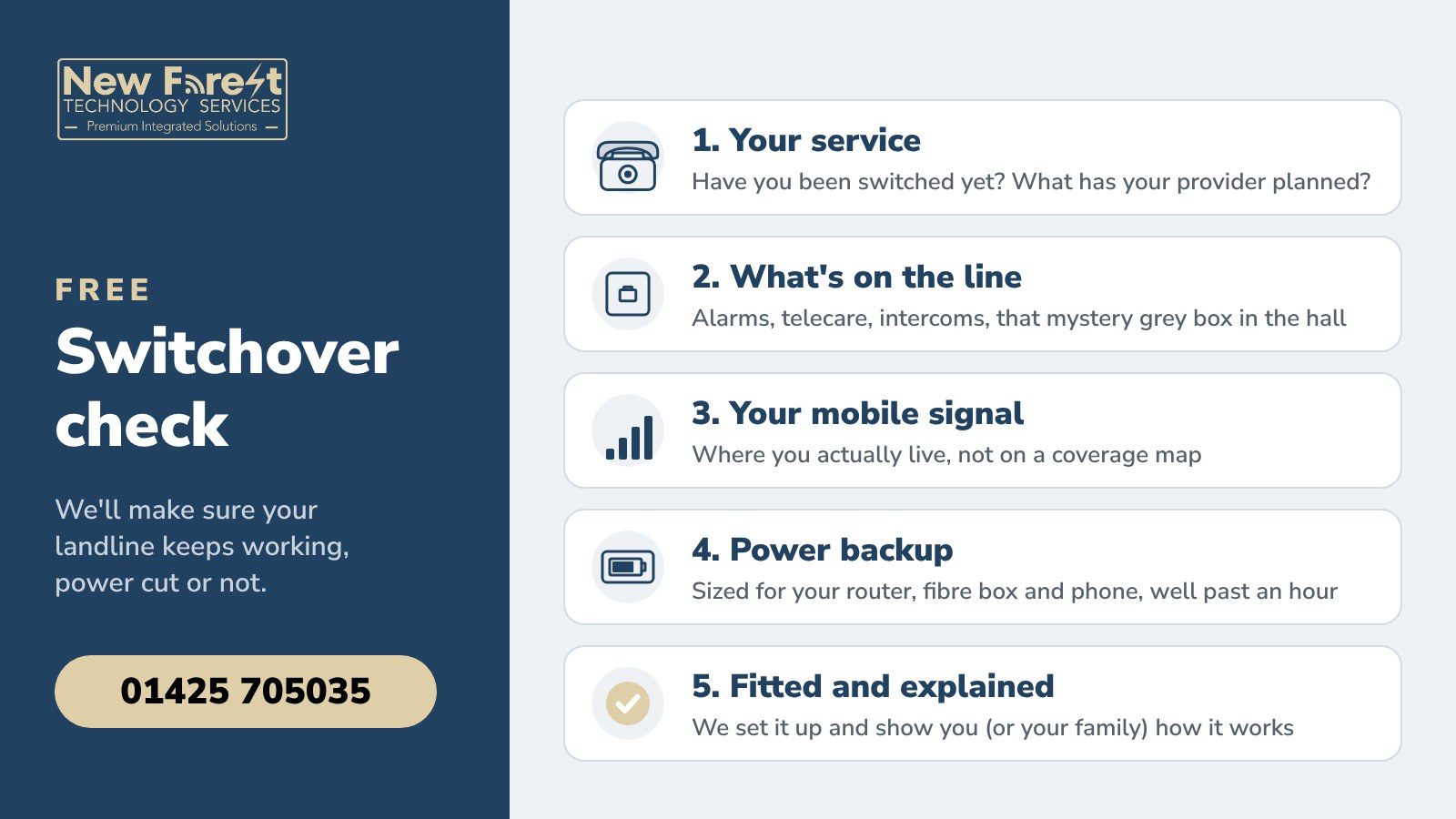
Book a free switchover check. We'll:
Check your service — whether you've been switched yet, and what your provider has planned
Find everything on the phone line — alarms, telecare, intercoms, Sky boxes, that mysterious grey box in the hallway
Check your mobile signal where you actually live, not on a map
Recommend the right power backup for your router, fibre box and phone, sized for longer than an hour
Fit it and set it up if you'd like us to, and show you (or your family) how it works
No pressure, no jargon, just friendly advice (and maybe a shared sigh about technology).
Call us on 01425 705035 or get in touch here.
Download our free 4-page guide, in plain English, to keep by the phone or pass to someone who needs it: The Phone Line Switch-Off — A Plain English Guide (PDF)
Facts correct as of November 2026. The switch-off date and rules come from BT, Openreach and Ofcom; your own provider's plans may differ, so it's always worth asking them.